.png)


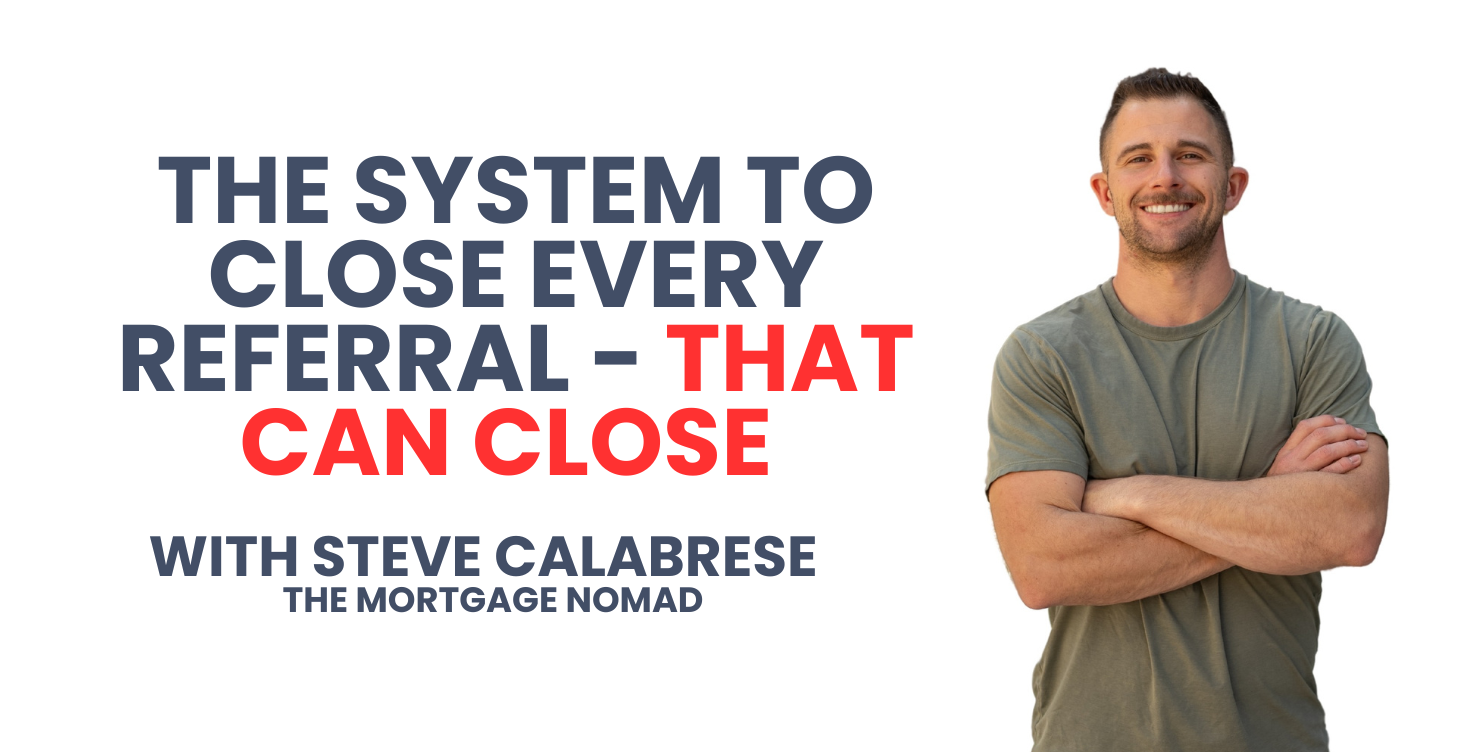
Unapologetic is one way I can describe @Steven Calabrese
Steve is someone who has really opened my eyes to building a mortgage business on your own terms.
From spear fishing the flordia keys, to moto biking riding across 3rd world countries with nothing but a laptop and his flip-flops
Steve does not let his business get in the way of living a BIG life
He also doesn't let being a Loan Officer define him, nor does it require him to sit 10 hours behind a computer each day.
Aside from being a loan officer, he has built CRM-U - a system you can install into your business that closes every referral -- that can actually close
Below is the summary of our live call --
Summary
Alex Hernandez and Steven Calabrese discussed the critical need for organizing CRM data with specific tags to enable automated and targeted communication, with Alex Hernandez sharing their four-step qualification framework and "pre-close" technique that successfully converts clients. Steven Calabrese emphasized the necessity of documented Standard Operating Procedures (SOPs) for every lead onboarding interaction, noting that the major failure in the mortgage industry is the lack of a dedicated sales pipeline for leads prior to processing. Steven Calabrese advised attendees, including Chris Haliburton and Joe Elizondo, to commit to a single, white-label CRM system like their CRMU, stressing that ownership of one's data and systemization of the process are paramount for consistent success, which Jim Nolte confirmed is achievable with guidance.
Details
- Organizing CRM Data for Optimal Use Alex Hernandez emphasized the importance of organizing CRM data, specifically tagging clients (past, ratewatch, real estate agents) to facilitate targeted segmentation for communication in a system like Rate Update. They explained that a well-organized CRM allows for automated, segmented communication, such as weekly emails for agents versus monthly emails for past clients, making the process much more efficient than individually adding contacts to segmentations. Alex Hernandez noted the need to develop knowledge resources to help new clients organize their CRMs to maximize the benefits of Rate Update.
- The Challenge of Explaining Complexity Steven Calabrese shared that he identifies his "superpower" as explaining complicated concepts to people, recognizing that the mortgage industry's processes are extremely complex with many moving parts. Alex Hernandez agreed with the complexity but noted that once a strong foundational platform is built, all subsequent data and criteria become organized and automated, which simplifies everything. Steven Calabrese concluded that the most significant obstacle is the lack of adoption of these systems by people.
- Standard Operating Procedures (SOPs) for Lead Onboarding Steven Calabrese highlighted the critical need for Standard Operating Procedures (SOPs) for every lead entering a mortgage business, as it is the source of all income. They mentioned that an SOP should exist for every interaction, such as when a referral calls, even if the SOP is not formally written down. Alex Hernandez confirmed that they use specific "word tracks" every single time a lead calls, having burned the process into their brain, which allows them to efficiently and consistently qualify clients regardless of their own mental state.
- Alex Hernandez's Four-Step Qualification Framework Alex Hernandez detailed their consistent approach to initial client calls, which includes light humor to build rapport, followed by an immediate dive into the client's needs. The qualification process centers on a four-step framework that reviews a client's Credit, Down Payment, Debt-to-Income (DTI) ratio, and Income/Work History. Alex Hernandez uses the client's expected payment to gauge realism and determine affordability, aiming to keep the DTI ratio well under the 50% limit in a rudimentary example.
- The Importance of the Pre-Close in the Sales Process Alex Hernandez uses a "pre-close" technique by asking the client if they did a good job explaining the process, which, upon an affirmative answer, makes the transition to asking for the client's Social Security number a seamless, "beautiful transition". If the client objects to providing their Social Security number, Alex Hernandez uses their previous agreement that the process was well-explained to pull out underlying objections, such as the client merely "shopping around" for rates. Alex Hernandez stated that this technique works successfully for approximately 24 out of 25 people.
- Demonstrating Efficiency and Process Adherence Alex Hernandez recounted a recent instance where a referred client, Cole Wilson, reached out late in the evening because their current broker was unresponsive and slow. Alex Hernandez offered a call, and within 20 minutes, the client had a pre-approval letter, which demonstrated superior efficiency compared to the other lender who had taken all week. Steven Calabrese agreed that the swift action highlighted the widespread lack of SOPs and consistent processes in the industry.
- The Nature of SOPs and Consistency Steven Calabrese clarified that SOPs can exist mentally, particularly for high-volume activities performed over years, but should ideally be documented. Alex Hernandez emphasized that systems are crucial because they operate regardless of a loan officer's intuition, feelings, or stress level, providing consistent service. Alex Hernandez suggested that many loan officers overlook the need to formalize their process, leading to inconsistent business outcomes and emotional compounding during bad months.
- Training Gaps in the Mortgage Industry Steven Calabrese posited that the reason loan officers fail to follow up on lucrative leads is due to a lack of proper training; while most academies teach underwriting and loan closing, they spend no time on front-end systems, marketing, branding, or lead systems. Alex Hernandez agreed, noting that assumptions about a client's qualification can lead to missed opportunities, which is costly, especially in the current market. Steven Calabrese concluded that the 2021 playbook is largely irrelevant for the current market.
- The Necessity of Adopting a System Steven Calabrese advised that all loan officers should adopt and fully commit to a system, whether it is a physical notepad like their father uses to close significant volume, or a sophisticated CRM. However, Steven Calabrese stressed that their personal preference is a more efficient system than a notepad, and they offered to show their "badass system". Alex Hernandez reiterated the value of breaking down the lead onboarding process into granular steps and using consistent word tracks, which can be performed regardless of the environment.
- Lead Onboarding and Data Management Steven Calabrese termed the discussion topic as "lead onboarding," emphasizing that this initial contact stage is where all income originates. Alex Hernandez explained that their average consultation takes only 10 minutes to qualify a client, build rapport, educate them, and take their application, with the gathered information later transcribed to the Loan Origination System (LOS). Alex Hernandez confirmed that consistent follow-up, even a simple call when promised, sets a low bar for the industry and ensures client retention.
- Divergent System Architectures for Success Steven Calabrese acknowledged that their approach differs from Alex Hernandez's, noting that Steven Calabrese does not take applications over the phone but uses loan partners for follow-up and a different system. Steven Calabrese affirmed that success is achievable through various systems, provided individuals decide what kind of business and life they want to run. Alex Hernandez praised Steven Calabrese for challenging the "old way" of doing business and confirmed that systems help distinguish one professional from others in an industry where the product (money for a house) is a commodity.
- The CRM and Sales Pipeline Steven Calabrese showed their personal mortgage CRM, which they use instead of the LOS (like Encompass) for front-end lead management and sales. They emphasized that a work number separate from one's personal cell is crucial for marketing and lead capture via the CRM. Steven Calabrese's SOP for every incoming lead involves manually entering contact details into the CRM, taking notes, tagging the lead (type of buyer and source), and sending a manual application email via Outlook before triggering automated follow-up via text and email.
- The Need for a Sales Pipeline for Leads Steven Calabrese argued that the lack of a dedicated sales pipeline for leads prior to processing is a massive failing in the mortgage industry, unlike virtually all other sales sectors. Forest Knott confirmed they use a high-level CRM (Go High Level) but struggle with committing to moving leads through the milestone-based pipeline, particularly after the pre-approval stage. Alex Hernandez received an automated text message from Steven Calabrese's system, confirming the efficiency of the automated follow-up.
- Compounding Value of Automation and Database Management Steven Calabrese clarified that the benefit of an automated follow-up campaign is not 2-3% more conversions but realistically 20-30%, potentially closing 60-70% of all referrals, provided they are closable. Steven Calabrese stressed that building a CRM system from scratch is too time-consuming, requiring 500 hours, and recommended using a customizable system built on a platform like High Level (a white label system). Alex Hernandez agreed that for established loan officers, paying for a proven system like Steven Calabrese's CRMU is far more efficient than attempting to build one from scratch.
- Database Migration and Data Security Steven Calabrese emphasized that gathering one's existing database, particularly past clients, is crucial because a yellow notepad cannot automate follow-up. Steven Calabrese instructed participants to get their data from their company's LOS, which they warned is dangerous if the loan officer ever leaves the company, into a web-based spreadsheet (like Google Sheets), and only then look for a CRM. Steven Calabrese offered to share a template for this data organization.
- Committing to a Single CRM System Chris Haliburton, who uses Go High Level but has not uploaded data, asked about a system that could handle a large upload of 4,000 past contacts with AI features. Steven Calabrese advised Chris Haliburton to commit to a single CRM, emphasizing that there is no system that instantly markets an uploaded database. Steven Calabrese stressed that the first step must be plugging the immediate "holes" in the lead onboarding process before focusing on the database. Chris Haliburton's concern about using a partner's CRM and data access was validated by Steven Calabrese, who emphasized that loan officers must pay for their own system to maintain ownership of their data.
- Choosing the Right CRM Solution Steven Calabrese clarified that using the base Go High Level platform requires significant learning and time. They advised Chris Haliburton to choose a white-label version of High Level, like CRMU, RAD, or another established system, to get a pre-built, customizable solution. Alex Hernandez and Steven Calabrese concluded that the industry offers a proven product (money for a house), and success relies on systemizing the process efficiently, which is only overwhelming if one tries to build the system alone.
- Sales Process and Lead Conversion Systems Steven Calabrese prompted a discussion on sales systems, noting that all income flows through a funnel and emphasizing the need for one. Joe Elizondo mentioned that their process for handling calls involves picking up the phone and building rapport to lead into understanding what the client is trying to accomplish. Joe Elizondo also shared they are experiencing "analysis paralysis" with various systems like High Level and Follow Up Boss, trying to figure out which one to use.
- Alex Hernandez's Client Conversion and Communication System Alex Hernandez detailed a system focused on responsiveness and over-communication when converting a client referral from an agent like Joe. Their process includes texting the client, sending a screenshot of a scheduled appointment back to the agent for confirmation, and providing updates after the call, including securing an application. Alex Hernandez explained that they keep the referral partner continuously in the loop with multiple text messages, believing they are single-handedly ensuring the agent can feed their family through the transaction, which builds trust. Alex Hernandez also shared their non-traditional CRM approach, using only their phone's notes app and reminders for client follow-ups, customizing their phone screen for calendar and daily follow-ups.
- CRM Implementation and System Development Jim Nolte, who is working with Steven Calabrese’s CRM, shared that they are close to fully implementing the system after about four months of work, which involved integrating data and setting up workflows. Jim Nolte appreciated Steven Calabrese's help with templates and built-in workflows and is looking forward to the rate update integration. Alex Hernandez stressed that implementing and perfecting systems takes time, but a "halfbaked system is better than no system at all". Alex Hernandez offered personal examples of system issues, such as all emails going out five times initially, but noted that their Rate Update system still closed $2.5 million in refinances last year that would have otherwise been missed.
- Future Rate Update Features and System Commitment Alex Hernandez announced that Rate Update is migrating to a new email infrastructure with custom subdomains and mentioned a high volume of emails recently sent. They also revealed that by the end of Q1, Rate Update plans to introduce SMS functionality for integration partners like Steven Calabrese's CRM, allowing agents to send weekly digests via their existing business lines. Alex Hernandez concluded by encouraging the audience to see system implementation as a compound effect. Steven Calabrese emphasized the importance of committing to a system, urging attendees to "just do something" and use the learned system for the rest of their career.
Learn more about CRM-U Here